Use the whiteboard during a lesson
The whiteboard is the heart of every Class Spot lesson. You write, draw, and work alongside your student — in real time, in the browser, with no installs. This article is the high-level overview: where to find a board, what's on the toolbar, and how a board behaves between lessons. The deeper topics (adding materials, screen sharing, action control, downloads) each have their own article — see the Related section at the bottom as those go live.
Three kinds of boards
It's worth knowing which board you're on, because each behaves differently:
| Where the board lives | Persistence | When to use |
|---|---|---|
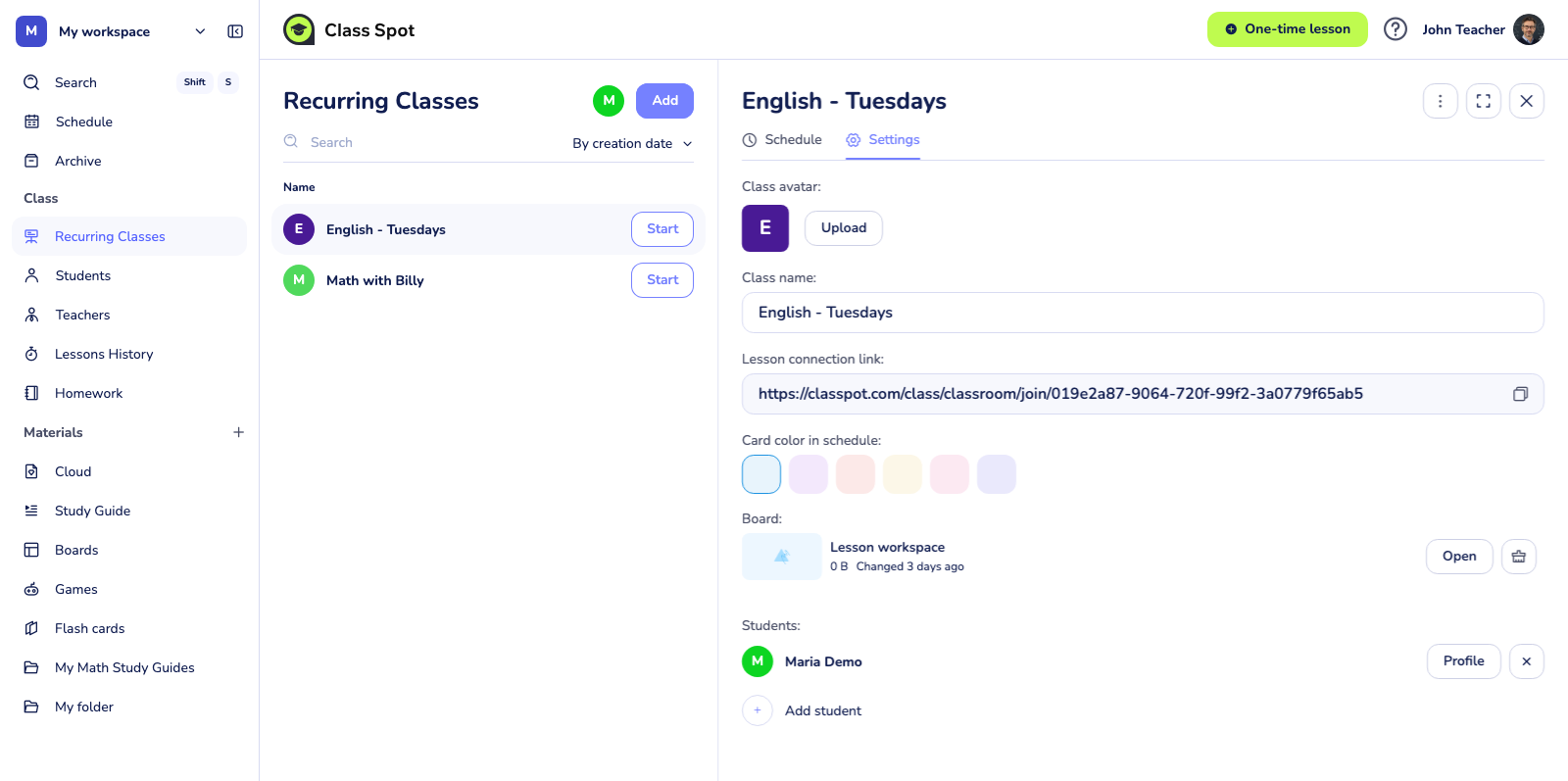
Recurring Class (Recurring Classes → [your class] → Settings → Board) |
Permanent — same board across every lesson of this class. | Ongoing students, weekly sessions, anything you want to come back to. |
| One-time lesson (top-right header One-time lesson button) | Ephemeral — blank board each click, no persistence after the lesson. | Trial lessons, prospects, single-session interviews. |
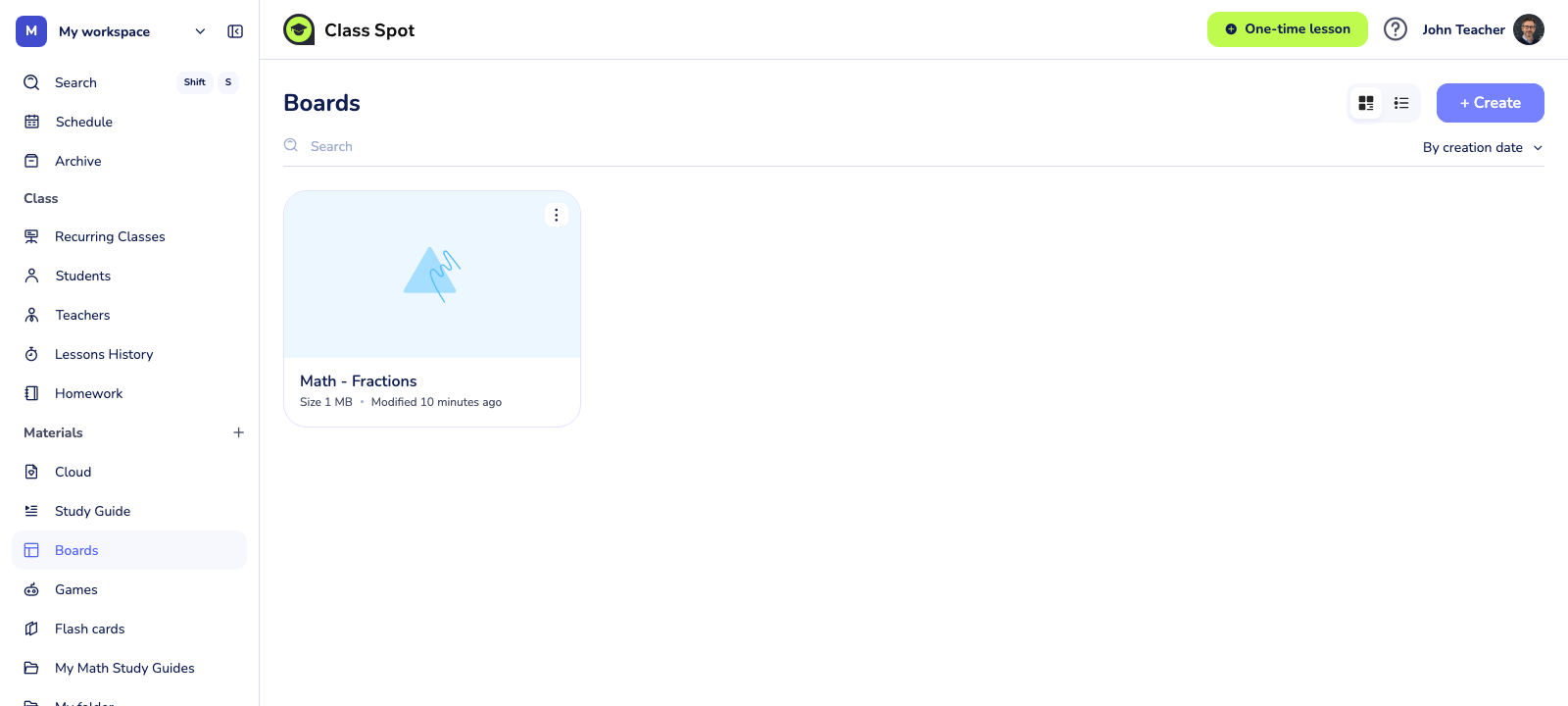
Board preset (Materials → Boards → + Board) |
Saved as a reusable template you can load into any lesson. | Pre-built exercises, lesson plans you reuse with different students. |
If you find yourself rebuilding the same activity for every student, save it as a preset under Materials and load it instead.
Where each one lives in the cabinet:
Recurring Class — Settings tab → Board section. Open the class, switch to Settings, scroll to Board. Click Open to enter the board, or the lesson auto-loads it when you click Start.
One-time lesson — top-right header. The green One-time lesson button is in the page header, available from any screen in the cabinet.

Board preset — Materials → Boards. All your saved presets live here. Click + Create to make a new one, or open an existing preset to edit it.
The toolbar — what each tool does
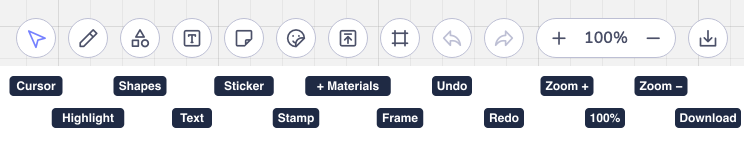
Open any lesson and you'll see the toolbar along the side of the board.
Drawing and writing
- Pencil. The most-used tool. Adjust line thickness, write with a mouse or a graphics tablet. Good for formulas, free-form notes, corrections.
- Color. A palette of ten colors. Use color to emphasize a point, mark mistakes in red, or highlight a key answer.
- Geometric shapes. Circle, oval, square, triangle, line, arrow. Snap-to-grid keeps diagrams clean. If you need a shape that isn't there, upload it as an image (see below).
- Text. Add typed text blocks for definitions, titles, and prompts you don't want to draw by hand.
- Eraser. Erase pencil strokes precisely — useful for "fill in the blank" exercises where you erase part of a formula and ask the student to complete it.
- Undo / Redo. The standard pair. Works during the lesson and during board preparation.
Navigation
- Board scale (zoom). Zoom in for detail work or out to see the full board. The board canvas is large — you can plan two to six lessons worth of content on a single board and use only part of it per lesson.
- Pan. Click and drag (or use the navigation tool) to move around the board.
What lives in the lesson room beyond the toolbar
A few more sets of tools live in the lesson room — each gets its own article so we can cover them properly:
- Add materials to the board — files, study guides, flash cards, games, and the cloud library. Article coming soon.
- Restrict student actions — pencil only, view only, no uploads. Article coming soon.
- Share your screen. See Share your screen in a lesson.
- Download or save the board as a preset. Article coming soon.
How the board behaves between lessons
This trips people up, so it's worth being explicit:
- Recurring Class board: everything you draw or upload stays. Open the class next week and your notes are still there. Use this as a running notebook for the student.
- One-time lesson board: the moment you close the room, the board is gone. Don't put anything on a One-time board you wanted to keep — save it as a preset before you leave.
- Board preset: changes you make to a preset during a lesson don't overwrite the original by default. You'll be asked whether to save the changes back to the preset or keep them only for this lesson.
Plan limits at a glance
| Capability | Free | Solo Pro | Solo Max | Business |
|---|---|---|---|---|
| Whiteboard tools | ✓ | ✓ | ✓ | ✓ |
| Screen sharing | ✓ | ✓ | ✓ | ✓ |
| Number of saved boards (presets) | up to 3 | unlimited | unlimited | unlimited |
| Share Whiteboard with another teacher | ✓ | ✓ | ✓ | ✓ |
| Max lesson length | 40 min | extended | extended | extended |
For the full plan comparison, see Compare Class Spot plans.
Tips
- Plan a few lessons on one board. The board canvas is wide. Lay out three or four lessons side by side, then use the zoom and pan to walk through one at a time. Easier than rebuilding every week.
- Use color for feedback. Write your student's answers in their own color, then mark corrections in red. Visual continuity helps memory.
- Don't fight the wrong board. If you opened a One-time lesson and started working, your notes won't be there next week. Save them as a preset, or switch to a Recurring Class so the board persists.
Troubleshooting
The board feels slow or stutters.
- Refresh the page once (Ctrl/Cmd + R). Brings the board state into a clean local cache.
- Check your internet speed — the whiteboard syncs continuously, so it's sensitive to packet loss. We recommend 5 Mbps down / 2 Mbps up minimum.
- Remove large, unused files from the board. A 50 MB PDF that nobody is annotating slows the whole canvas.
Something I drew has disappeared.
- The student or co-teacher may have used the eraser or Undo. Press Redo to recover the last action.
- Make sure you're on the same board view (zoom and pan state are per-user; the content is shared).
The student can't see what I'm doing.
- The board is shared in real time. If the student sees a blank canvas while you're writing, ask them to refresh. Persistent gaps usually mean a slow connection on their side — check the audio: if the audio is also stuttering, it's a network issue.
I want to undo only my last stroke, not the student's.
- Undo is per-user — your Undo only rolls back actions you made, not the student's. If your student drew something you'd rather they hadn't, ask them to undo, or use the eraser on that area.
If nothing above helps
Contact us:
- In-product chat — click the green chat bubble in the bottom-right of your cabinet, then Start Conversation.
- Email — info@classpot.com.